Showing posts with label poultry and wildfowl. Show all posts

Friday, September 2, 2011

Chicken breasts baked on a bed of mushrooms (p. 425)

Some of you are probably wondering why I was at my mother's house for so long (although you are far too polite to ask). I went home to Iowa for a few days to have a simple mechanical error looked at by a trusted mechanic, had my car dramatically break down, and spent well over a month trying to get it figured out. It was terribly stressful because I kept thinking I was going to leave within a week and then something else would go wrong on my car. It's one of the joys of owning an aging car. I also happened to have the puppy with me. You wouldn't think that a small dog like Lestat (who weighs less than 10 pounds) could bring down a screen door but you would be wrong. He's like a little whirling dervish of destruction. I think my mom was glad to see him go.

On the bright side, I was able to cook a whole bunch of things that Josh was not interested in eating or that I suspected I wouldn't like, which is why a lot of chicken recipes and bell pepper recipes have been cooked.

Chicken breasts baked on a bed of mushrooms (p. 425) doesn't fit in either of those categories but mom happened to have chicken. It looked easy but I haven't had great luck with TJOC's chicken recipes.

I cut up cremini and button mushrooms and spread them out on the bottom of a roasting pan. I added white wine, minced garlic, and salt and pepper to the pan:


I placed the chicken breasts (which had been seasoned with salt, pepper, and thyme) on top of the mushrooms:


And it was cooked for about twenty minutes:


I removed the chicken and poured the pan juices in to a pot, along with chicken stock and heavy cream, and boiled the sauce until there was only about one cup of juice. It went from this:


To this:


I should have taken a final picture of the whole dish. You will have to use your imagination.

I wasn't in love with this recipe. It was okay. The sauce was tasty but could have used a little more kick (more garlic, more pepper, a little cayenne, something more). The whole thing was a little boring. I think it would have been slightly better if it had been baked in a really tiny pan so the mushrooms could be infused with chicken-y flavor but the pan I used was actually quite small. I would recommend this recipe to people who don't like heavily seasoned food.

Add to Technorati Favorites

Friday, July 1, 2011

Mediterranean boneless chicken breasts baked in foil (p. 439)

Mom told me that she had boneless, skinless chicken breasts and asked if there was something that I could make out of them. We agreed that Mediterranean boneless chicken breasts baked in foil (p. 439) looked good (and, more importantly, mom had most of the ingredients).

I combined finely chopped brine cured black olives, oil packed sun-dried tomatoes, olive oil, and basil (super fresh basil, straight off mom's plant):


I placed a chicken breast on a piece of oiled foil (poetry!) and spooned some of the olive mixture on the top.


I wrapped each one of the chicken breasts up nice and tight in the foil:


And into the oven they went.

When the foil packets were opened up, the chicken was certainly colorful and attractive:


...and surprisingly bland. I don't know how it was bland because it had so many strong flavors (olives, sundried tomatoes, basil) but it was very boring. It was also oddly tough, which surprised me, because I thought that the foil method would protect against overcooking.

If I was to make this recipe again (which is doubtful) I would season it a LOT more. I would add garlic, at the very minimum.

Does anyone use the pouch method regularly? It seems like extra work with no payoff to me.

Add to Technorati Favorites

Friday, March 25, 2011

Chicken or turkey pot pie (p. 103) , Poached chicken or turkey (p. 423), Creamed chicken or turkey I (p. 445),& Deluxe butter pie or pastry dough (665

I've been in a cooking rut lately and wanted to do something new. So I stole Carol Porter's idea and I let my readers pick what I should make out of three categories with five choices each. Chicken or turkey pot pie (p. 103) won the savory category. I'm rather glad because it allowed a lot of other recipes to be knocked out. I will admit right now that I'm no pot pie aficionado and most of my pot pie experience comes from the cheap frozen ones that cost a dollar.

I started by making Poached chicken or turkey (p. 423). I put my chicken parts (I cut up a whole chicken--much cheaper that way), carrots, celery, chicken stock, an onion, and bouquet garni into a stockpot and covered it with water. I simmered it all until the chicken was tender:


The chicken peeled right off the bone:


The poached chicken was deliciously tender. I poach chicken constantly when I make stock and it's great in recipes because it's tender and moist. The recipe was certainly easy and I used the broth for stock but I think I will stick with my chicken stock recipe which yields the same results.

I needed the poached chicken for Creamed chicken or turkey I (p. 445). I melted butter in a saucepan and then added flour, whisking until smooth.


I removed the pan from the heat and whisked in two cups of the cooking broth from the poached chicken:


When that was smooth, I added half-and-half and whisked some more:


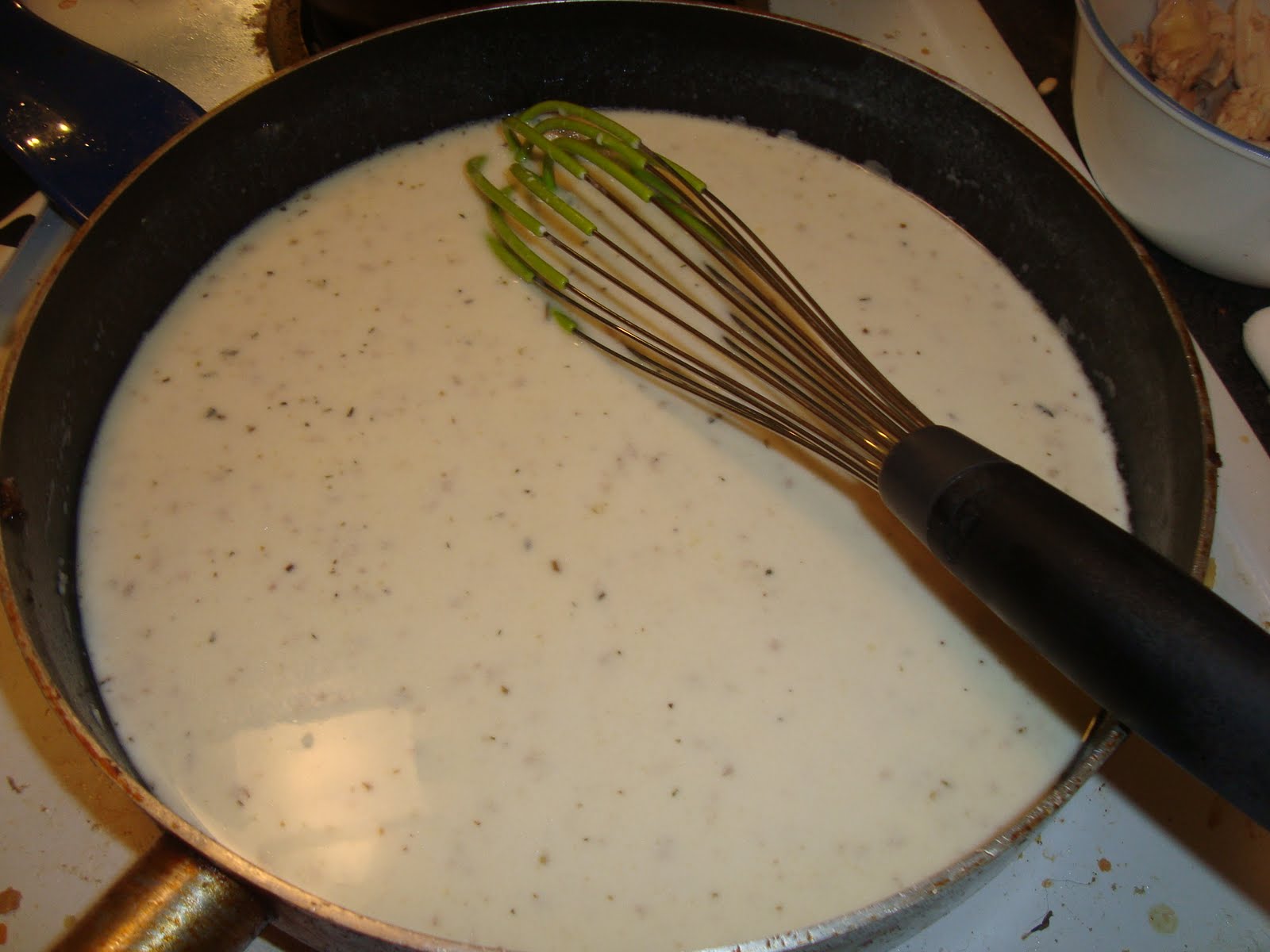
I whisked and whisked. The cream mixture got thick:


I must have been tired of taking pictures at this point! I heated butter, added onion, carrots, and celery, and cooked. I then added peas and parsley, along with the cooked chicken.

I realized that TJOC wanted the pot pie to go in to a 9x13 pan. Wait a minute--a 9x13 pan???? I thought they went in pie dishes? That is going to make a TON of pot pie! I only have one 9x13 pan and it was still in use by the strata so I had to divide and conquer. The pies went in to two smaller pans:


I've actually never tried my hand at a pie crust before. This is particularly strange because I come from a family that is full of amazing pie bakers. I've watched crusts get made tons of times but I've never made a crust that had to be rolled out, likely due to my fear of recipes that require me to use a rolling pin. I decided to start with the Deluxe butter pie or pastry dough (pate brisee) (p. 665). I sifted together flour and salt:


I added butter and vegetable shortening:


I started working it over with my pastry blender:


I eventually incorporated ice water and kept pastry blending it.

But when I tried to roll it out, it did not work! The dough stuck to everything, it wouldn't stay in one piece, it was a disaster. I'm sure there is a simple explanation for this.


I tried Frankensteining my crust on the top of the pot pie. Isn't it the most pathetic thing?


I brushed an egg on the top:


And baked my pot pies:


Absolutely shockingly, my pot pie was delicious! The crust was flaky (although I'm sure it would have been flakier had I made it correctly) and the center was creamy and full of tender chicken and perfectly cooked vegetables. I loved it. Unfortunately, it made a massive, massive amount. The recipe says 6-8 servings. Are they kidding? For who? Growing teens? Yes, maybe it would feed 6-8 kids on their high school basketball team. We ended up having to throw quite a bit away because it was a neverending amount! I'm sure I will make this recipe again because I have to make another type of creamed chicken and I have no idea what to do with creamed chicken except make pot pie.

I always thought pot pies had a crust on each side. Is that not true?

Random facts:
  • Because this crust doesn't include any leavening agents, it doesn't puff up.
  • While reading Wikipedia, I figured out that I don't think I blended my crust enough, so my flour and fat didn't get properly incorporated. I will have to work on that.


Add to <span class=Technorati Favorites">

Monday, March 7, 2011

Brunswick stew (p. 432)

My reasoning for making Brunswick stew (p. 432) was different than my usual rather random recipe selection. Carol Porter is a newspaper columnist and blogger with this truly novel (and awesome) idea that she would post cookbooks, and then recipes from those cookbooks and let her readers decide which cookbooks she would cook from and which recipes she would cook out of each cookbook. An old edition of TJOC was one of her cookbooks of the week and Brunswick Stew was one of the winners. I thought it would be fun to see if the new editions version was the same as the older edition.

I've previously put off this recipe because it is SUPER long. If you have a copy of TJOC handy, look it up. It's not very welcoming.

To start, I browned chicken pieces. Now, TJOC insinuates that you should use bone-in, skin-on chicken pieces. The skin gets soggy and I hate digging around in a stew, trying to cut away from the chicken bone. I boned out all the chicken (thighs) and took the skin off.


I cooked onions and celery until they were just tender:


I added the chicken back into the pot, along with lima beans, tomatoes, barbecue sauce (homemade, of course), tomato puree, chicken stock, garlic, bay leaves, salt, pepper, and ground red pepper. It was at this point that I found out Josh hates lima beans. Now, I know most people seem to not like them but Josh HATES them. When he ate the finished product, he ended with a little pile of lima beans on the side of his dish.


The whole thing cooked for almost an hour. When the chicken was tender, I added in corn:


The whole thing cooked for about ten more minutes and I seasoned it with a few drops of Tabasco, a few drops of Worcestershire sauce, and a little more salt.

How was it?

Surprisingly good! I thought the stew was a bit odd because it did have a strong barbecue flavor at first but the flavors really mellowed (and melded) as it sat in the fridge. The stew was hearty and really tomato-y between the canned tomatoes, the barbecue sauce, and the tomato puree. It was absolutely divine with a few pieces of crusty bread. I would absolutely make this again. Although it looks like a really long recipe, it's quite easy and most of the ingredients are items you probably have on-hand. And give the poor lima bean another chance--it has a nice, creamy texture in the stew and is probably better than you remember.

Random facts:
  • There is a debate about where Brunswick stew actually originated with Brunswick County, Virginia, Brunswick, North Carolina, and Brunswick, Georgia all throwing their metaphorical hats in the ring (Oxford Companion to American Food and Drink, p. 72)
  • Squirrel is the traditional meat in many Brunswick stews (Wikipedia, OCAFD, TJOC)
  • Brunswick stew is traditionally a side for barbecues (OCAFD, p. 72). That would account for the barbecue sauce!


Add to <span class=Technorati Favorites">

Saturday, January 15, 2011

RCD7: Roast duck a l'orange (bigarade), Roast duck (p. 447), and Sweet-sour orange pan sauce (p. 548)

Rachel cooking day post #7

It's hard to know why we decided to make Roast duck a l'orange (bigarade). I think it's partially because we found a duck that was priced within our budget and I knew there was a duck recipe on the randomly selected list. We actually found guinea hen, pheasant, and goose, too (although we didn't buy them).

Rachel and I discussed an issue that constantly comes up and I'd really like to have some other opinions on the subject. Although less than previous editions, the 2006 edition of TJOC still has a sizable amount of recipes that require you to make other component recipes. My rule of thumb is that when you can still judge each component piece (as in Steak Diane), I count all the pieces (the sauteed steak, as well as Steak Diane). When they all meld together (Mashed potato stuffing will be one, when I get to it), I can only judge the final piece. Do you think that is fair?

Roast duck a l'orange is essentially just Roast duck (p. 447) with Sweet-sour orange pan sauce (p. 548) poured over it. In fact, that's exactly what it is--the TJOC recipe for duck a l'orange is only three sentences long. It is exactly the sort of recipe that people mean when they say they hate all the flipping that you have to do when cooking with TJOC.

I feel I can count off all three recipes with this one.

My duck:


I took the duck, popped it in the electric roasting pan, and cooked it for just over an hour:


Easy!

Time for the pan sauce. I removed the zest from an orange using a vegetable peeler, an incredibly easy zest removal method that I had never thought of previously. It took the perfect amount of zest with no pith. I cooked the zest for about a minute in boiling water, drained the zest, and then rinsed it again:


We poured chicken stock in to the roasting pan and simmered it, scraping up the browned duck bits:


I cooked white wine vinegar and sugar in a saucepan until they started to brown and then added the contents of the roasting pan.


I stirred together cornstarch and water until smooth and added it to the sauce, simmering for one minute. The orange zest was added, along with orange juice, a bit of Grand Marnier, lemon juice, and salt and pepper:


The sauce was poured over the bird, resulting in duck a l'orange.

Like a huge idiot, I don't have a final picture of the finished product.

This wasn't a true "bigarade" because we didn't use a Seville orange.

Rachel and I had been joking for days that we would be eating duck at midnight. We both didn't care because we weren't planning for true "meals" but rather to snack as dishes were ready. Of course, at 11:57 pm I was pouring the orange sauce over the duck. We ate duck at midnight.

The duck was good. It's definitely better if you like dark meat, which I do. The sauce was very, very orange-y, so stay away from this one if you don't love orange flavor. The roasting method resulted in a terrific crispy skin that was absolute perfection.

Random facts (if no reference, then it's my personal knowledge):
  • Almost 75% of all the citrus fruit produced in the world are oranges (On Food and Cooking, p. 375)
  • Ducks are mostly dark meat due to the high concentration of red muscle fibers, a requirement for migratory birds
  • Grand Marnier uses the "distilled essence" of the bitter orange (Wikipedia)

Add to <span class=Technorati Favorites">

Wednesday, September 29, 2010

Sauteed breaded boneless chicken breasts (p. 436),Chicken parmigiana (p. 437), and Eggplant parmigiana (p. 273)

I would absolutely love to write a very clever choose-your-own-adventure style post for this post but it's not going to happen--I'm not having a very creative day. In fact, I'm trying to pound out these posts as fast as I can so I can update my index and get an accurate idea of how far I am in the project. In fact, I should make that a contest--how far do you think I am in the book? Honestly, I would love to know what people think!

I decided to make two types of Parmesans (if I was in a place where I could easily find veal, I would have make all three types). I've never been much of a fan of chicken/veal/eggplant parmesan. They always seem to be bland, overbreaded, and covered in too much cheese and mediocre sauce. I didn't have particularly high hopes for the recipe.

The first step was to make Sauteed breaded boneless chicken breasts (p. 436).

I pounded the chicken breasts in a plastic bag. I always pound meat this way so that it doesn't fling bacteria-laden juices all over the kitchen and it really helps with clean-up.


I set out my three battering bowls. They included:
1. An egg with some water.
2. Bread crumbs, dried herbs, salt, and pepper. I omitted the Parmesan cheese so the end-product wouldn't get oversalted.
3. Flour.


I dredged the chicken in the flour, then the egg, then the bread crumbs:


Don't skimp on the egg mixture--it barely stretched as far as I needed it to:


I fried them in olive oil:


They were finished very quickly. The main problem was that it was difficult to make sure the whole thing was cooked through before burning on the outside--and I had to keep adding olive oil because the breading soaked it right up. I'm not sure what the solution to this would be--maybe turning down the heat? But they wouldn't get as crispy with lower heat.


The chicken was nicely flavored. It was sort of boring on its own but would have been really good with some sort of dipping sauce (a nice honey mustard, for example).

I decided to transform them into Chicken parmigiana (p. 437). I spread mom's tomato sauce all over the bottom of a dish (the other dish was sauced for eggplant parmigiana).


I arranged the chicken in the pan, sprinkled them with grated Parmesan, and spooned the rest of the sauce over the top. I then topped it all with a little more Parmesan and some mozzarella.


I baked it for about thirty minutes:


Delicious! Have a light hand with the salt, though, because the Parmesan adds plenty. I think this recipe was balancing right on the edge of being too salty. Even so, the chicken parm was good, heated up really well, and even froze well. I think the recipe would be really easy to double or triple and make plenty for a group.

I decided to make it a double Parmesan day and make Eggplant parmigiana (p. 273) as well. After saucing the pan (as shown above) I spread fried eggplant, slightly overlapping the slices. I sprinkled mozzarella and parmesan cheese on the eggplant, along with oregano and pepper. I poured more sauce over the top and sprinkled a little parsley on it:


After about fifteen minutes in the oven the cheese was melted and it was bubbly:


I actually thought the eggplant parm was better than the chicken parm. Eggplant is one of the few veggies that can stand up to being fried, smothered with cheese and sauce, and still be recognizable as a vegetable (in my opinion). The creaminess of the eggplant was enhanced by the tangy sauce and the whole was even more delicious than the parts.

One note--have a very light hand with the salt. Both mozzarella and parmesan cheeses are salty and they can start overpowering the dish very quickly.

Anyone else made these recipes?

Add to Technorati Favorites