Friday, May 14, 2010

Grad weekend #6:Chicken and apple sausage (p. 516),Pan-broiled sausage (p. 517) Fruit salad or fruit cup (p.210),Honey dressing for fruit salad(p.578)

I originally meant to make a couple types of sausage for brunch but realized that I had only bought enough pork for my stuffing and not enough for my pork sausage. That left me with only one type of sausage--Chicken and apple sausage (p. 516).

I ground a couple pounds of chicken thighs--TJOC says to use the skin as well as the meat but I thought that would be too fattening for the crowd I was feeding, so I only used about a quarter of it. I boiled a cup of apple cider down to a syrup, and mixed my chicken, apple cider, dried apples, salt, pepper, sage, thyme, cinnamon, and ginger together.


I formed the sausage into patties and fried them according to Pan-broiled sausage (p. 517).


Essentially, the sausages were cooked until they were done:


The sausage was delicious but really heavy on the apple flavor. I'm usually not one for chicken sausage (and I still think the sausage would be much better with pork) but it was fun to make my own sausage mixture and I'm sure I will do it again.

I thought that it would be a good idea to have a fruit salad with brunch. I'm having trouble with the fruit section of TJOC because I'm allergic to most fruit (I have to carry an Epi-Pen) and it seems insane to make stuff that I can't eat when it's just the two of us. I became allergic to kiwi when I was about twelve, which was no problem, because I don't like it. Over the years the allergy has spread to papaya, bananas, mango, melon, and pineapple (I love pineapple, so that one I miss). Recently, strawberries have started giving me a reaction, which is really depressing. Piece of trivia--fruit allergies aren't that common, but kiwi is the fruit that is most likely to give a reaction (as well as leading to the worst reactions).

Even as a kid I liked making fruit salad, although I never liked eating it, so I'm known in my family for making a nice fruit salad (although how difficult is a fruit salad?). I decided to make Fruit salad or fruit cup (p. 210), without the honey.

I cut up and mixed together oranges, apples, a pear, a banana, and some blueberries.


I then made Honey dressing for fruit salad (p. 578). I mixed honey and lime juice:


It seemed like a strange combination to me. I assume the lime juice is to stop the fruit from browning. I mixed the fruit with the sauce and it was done!


Obviously, I didn't try the fruit salad but my family said that it was good. It had a strong honey flavor to it, so if you like honey, this would be a good choice. I think the combo of fruits was good but another colorful fruit would have made it much more pretty--if I made it again, I would probably add in some strawberries or peaches.


Add to Technorati Favorites

Grad weekend #5: Brunch! "Artichoke frittata for a crowd" (p.202)

I was pretty excited to have a crowd for which to cook "Artichoke frittata for a crowd" (p.202). I was pretty excited to be able to knock off a few breakfast foods and serving a nice brunch was the perfect choice, since graduation started at 3.

**I know some of you really enjoy when I find mistakes and there was an error in this recipe--stay tuned!**

I whisked together a dozen eggs (yes, a dozen), half-and-half, Parmesan, basil, salt, and black pepper.


I ran into a problem here--I don't have a 12-inch ovenproof skillet. I had a 6-inch skillet and an 8-inch skillet. I figured I could just make two smaller frittatas instead of one big one.

So I melted butter in my beautiful skillet:


(You will have to visualize some of the pictures here--juggling these frittatas was not easy and I neglected to take many pictures.)

I added chopped leeks and a garlic clove and cooked until soft. I added chopped artichokes--I chose against adding red peppers because I don't like them.

I then read the recipe about ten times. I read it out loud to my mom. I read it to my Uncle Denny. The recipe never mentions adding the egg mixture to the pan. I assume you add it at this point in the recipe, so that's what I did:


I cooked the frittatas over medium-low heat for what seemed like forever. Frittatas are not a good choice for people (like me) who like to hover over their cooking.

Finally, the edges started to pull away from the pan, which my godmother told me meant it was ready to be put in the oven. I popped the frittata in the oven and broiled it for about five minutes and it was done!

Again, it wasn't easy to keep everything going:


But the frittata was beautiful when it was done!


It was really delicious! It was light and fluffy and perfectly seasoned. Honestly, it was kind of nice to have two frittatas because everyone ate the first one while it was hot, then the second one came out when people were ready for seconds. My dad has been on the Atkin's Diet for over ten years and it was the perfect choice--it was super low in carbs.

That all being said, I'm not sure I will make another frittata. I was very stressed watching it vvveeerrrryyyy slowly cook. Well, I guess that's not totally true, I will make at least one more since there is another frittata recipe in TJOC--I will have to see how that one goes.


Add to Technorati Favorites

Grad post #4.5: The lost side dishes. Twice-baked potatoes (p. 297) and Creamed pearl onions (p. 287)
As I was reading TJOC, I realized I had missed a graduation post on the dinner side dishes. I am pretty proud of my graduation cooking--I was able to knock out about nineteen dishes over two days (putting me much closer to my 201 recipe in 2010 goal).

Twice-baked potatoes (p. 297) have always been interesting to me. I love potatoes but am usually underwhelmed by the twice-baked variety. They usually seem bland. I was nervous about making these because twice-baked potatoes have always seemed complex and time-consuming to me. On the other hand, they are a great side dish because they can be almost entirely made ahead of time and then just popped in the oven as needed.

Thankfully, for my nerves, my Uncle Denny was around and he was an expert on this particular dish! So he walked me through it. I took potatoes, cut them in half, and scooped out almost all of the potato. I added butter, hot milk, and salt to the pulp and then added it back into the potato shell. Well, to be honest, Denny added the mixture to the shell:


I sprinkled Parmesan and paprika on the top and popped them in the oven:


They weren't very difficult, which was a huge surprise to me. I've taken to making a ton of baked potatoes every couple weeks and this would be a really easy use for them. I think I could vary up the recipe with different cheeses and spices and really make a knock-out dish. They were tasty! I think they would have been even better with some bacon.

I also made Creamed pearl onions (p. 287). I'm not sure why I decided to make this recipe. If I was to refer to a vegetable as my enemy, it would be pearl onions, hands down. They are SUCH a pain. And you have to peel so many of them to make a reasonable dish. Even if you use the blanching method and force your mother to help you, it still takes about an hour. An hour than feels like twelve hours.


I like this picture because it looks to me like the potatoes are watching the caged onions.

I melted butter in a saucepan, added flour, and then added milk, half-and-half, salt, pepper, and a bit of nutmeg.


I poured the milk mixture over the onions and then topped it with delicious cheese:


It was baked for about fifteen minutes:


The pearl onions were really good! I would have thought that an entirely onion side dish would be way too strong but between the milk mixture, the mild flavor of pearl onions, and the delicious crisped cheese, it was really good. If you like onions, this is a dish for you. It's a pretty unexpected side dish.


Add to Technorati Favorites

Grad weekend #4: Crown roast of pork (p. 498), Spinach, mushroom, and ground meat stuffing (p. 538), and Spicy apricot sauce (p. 217)

On to the main course! I decided to make a big expensive cut of meat stuffed with a delicious stuffing as my showstopper. When I read the recipe for Spinach, mushroom, and ground meat stuffing (p. 538), it reminded me of my grandmother's ravioli recipe and sounded amazing (My Nonni makes the best ravioli in the world).

I cooked spinach, onions, and a lot of onions in butter--a perfect start to any recipe:


I mixed ground pork, fine bread crumbs, parsley, thyme, salt, pepper, nutmeg, and two large eggs in a bowl with the mushroom mixture. Note: Mix the eggs in before adding the spinach mixture (which is hot), otherwise you have to work really fast because the egg starts to cook.


I could barely stir the mixture--it was extremely stiff. Mom got to work:


The hole in the crown roast was really small, so we baked most of the stuffing in a bowl.


The stuffing was amazing! It was so delicious. It wasn't a bread-heavy typical stuffing but it had an amazing flavor and was really flavorful. I liked the combination of the pork, mushrooms, and spinach--this won't replace the cornbread stuffing at Thanksgiving, but I really enjoyed it.

The main part of the whole meal was the beautiful crown roast that we bought at a local butcher shop. (As an aside, their staff could use some more training--the man who sold it to us told us that he knew it was going to be good because it was pale. That is totally wrong information. Thankfully, he was incorrect and it was acceptable quality).

I've been very intimidated by recipes such as Crown roast of pork (p. 498) for two reasons. First, it's an expensive piece of meat. Second, it makes a HUGE amount of food and we are only a two-person household. So a special family weekend is the perfect time to roll a recipe like this one out.

I rubbed the pork with a mixture of olive oil, thyme, allspice, salt, and pepper, which looked distinctly like sludge.


I roasted it for fifteen minutes at a high heat, then reduced the heat to very low for about an hour. When it was an hour along, we stuffed it.


TJOC says to cook the pork roast until it's 155 degrees but my father, an expert in the field, recommended I remove it at 145 degrees, which is what I did. As it rested, it cooked until about 160 degrees, which is perfectly done for pork. Please, please, please don't ruin a piece of meat like this by cooking it until it's shoe leather.

Dad in action, with his granddog hopefully looking on:


The pork was amazing! It was tender and flavorful and the rub was perfection. The rub is more like a combination for a baked good but it was really good and not too strong. The roast easily fed nine, with leftovers. Most importantly, it was striking and perfect for a holiday.

For some reason, I thought that it would be perfect to have a nice sauce to pour over the pork. I'm not entirely sure why I wanted to add one more dish to the litany. I thought Spicy apricot sauce (p. 217) would taste delicious with pork. I had a vision of a beautiful bright orange sauce covering the pork and stuffing.

Canned apricots were surprisingly difficult to find at our grocery store! There was only one brand and I'm not totally confident that it was the full amount that TJOC required.

I combined a sweet onion, jalapeno peppers, and garlic in vegetable oil and cooked it until tender:


I then added the apricots, water, brown sugar, cider vinegar, Dijon mustard, and soy sauce and cooked it until the sauce had thickened:


I pureed it, added salt and red pepper, and it was finished!


Where is that beautiful orange color I was hoping for? The picture is actually a more attractive picture than the sauce actually was--it was a very strange yellow/orange. It didn't have a very strong apricot flavor but it was fruity and spicy. It was a popular dish and did spice up the meal (Ha! Spice up!). I never make a sauce to go along with meat but I think it's a great idea in general.


Add to Technorati Favorites

Graduation #3: Chicken liver mousse (p. 81) and Spinach and feta triangles (p. 89)

I thought the appetizer spread would also be a perfect time to make an option or two that I didn't want to eat. Chicken liver mousse (p. 81) is a perfect example of an appetizer food that I wouldn't eat unless I was on some sort of dare.

The start of the recipe looked promising--I cooked shallots and diced Golden Delicious apples until they are a little softened and added them to the food processor:


I cooked a pound of chicken livers until they were brown on the outside and pink on the inside.

I actually had to go back through this post and rewrite it because I feel so full of information. First of all, I've taken to buying airport sized liquors so that I'm not stuck with the whole bottle so I've really gotten knowledgeable about the range of tiny alcohol bottles. I knew nothing about cognac so I was blown away when I saw that a airport sized Courvoisier XO was TEN DOLLARS! I ended up with the much cheaper Hennessey, figuring that I know nothing about it anyway. I decided to educate myself (through Professor Wikipedia) on cognac.

There are three grades of cognac, with VS (Very Special) being the youngest, VSOP (Very Special Old Pale) in the middle, and XO (Extra Old) as the oldest. A little bit of trivia for the next night at the bar! Grand Marnier is a type of cognac that has been mixed with bitter oranges. And I always think of the Ladies Man on Saturday Night Live when I see Courvoisier.

I poured 3 tablespoons of Cognac onto the livers and attempted to light it:


And attempted. And attempted. And attempted. It did not light on fire. Maybe there was too much liquid in the pan? I gave up after a few attempts.

I added the liver mixture to the food processor (it was a tight squeeze):


At this point, TJOC says to drop cold butter into the machine with it running. Easier said than done when you have such a tiny processor and only two hands:


I scraped the entire mousse into a bowl and chilled it for a few hours.


Most of the guests were pretty happy with the mousse, which they ate on crackers. It smelled absolutely horrible. Between the smell and the consistency, it reminded me of cat food. My family reported that it was extremely appley but most of them liked it (one of them, who I won't name, ate it with a spoon!).

One of the best outcomes of TJOTJOC (thus far) has been totally losing my fear of phyllo. I still think it's a pain to use but I'm not scared of using it. And, really, foods wrapped in phyllo do look pretty impressive. Because they look impressive, I thought that Spinach and feta triangles (p. 89) would be a good addition to the menu.

Spinach and feta triangles are pretty similar to the Mushroom triangles that I made a few years ago (Wow! Time flies!). I sauteed some onion in butter, then added spinach and cooked the water off. I added feta, lemon juice, and black pepper to the spinach mixture.


I then rolled the phyllo like a flag, into little triangles (I went into more detail on this process in the linked post).


I baked the triangles until golden brown:


They were really delicious! Much better than the mushroom triangles and these were vegetarian, if you needed a veggie appetizer. I think this recipe could be adjusted for other mixtures too--I'm really interested in the idea of a ham and cheese triangle. Anyone have any other ideas for stuffing?


Add to Technorati Favorites

Grad weekend #2: Spanish-style marinated olives (p.71), Garlic-cheese spread (p.76), Marinated mushrooms (p.78)&Ginger lemongrass vinaigrette (p.57 )

I decided to make an appetizer spread for the first day that most of my relatives were showing up. I think this was partially because the only other big meals I've ever made were for Thanksgiving and that's usually what we do for Thanksgiving. It is a good idea, though, because the food can sit out and people can graze.

I thought Spanish-style marinated olives (p. 71) would be perfect since they could easily sit out and they took almost no work. I bought brine-cured green olives, brine-cured black olives, and oil-cured black olives at the Whole Foods olive bar and then added olive oil, garlic cloves, bay leaves, rosemary, and a bit of red pepper flakes. I then let it marinate overnight.


They were delicious and a big hit. The recipe makes four cups of olives but they keep in the fridge for up to a month. The garlic and rosemary flavors complimented the olives perfectly.

I also made Garlic-cheese spread (p. 76), which had actually been on my cooking agenda for a while. I mixed shredded Havarti (which doesn't shred easily--it's soft), a bit of mayonnaise, garlic, and chives.


I stored it for six hours and it was ready to go. Mom told me that a garlic-cheese dip is sold at the grocery store and my version had less mayonnaise, which mom sees as a real plus (she also said that Hy-Vee sells a cheddar version, so go wild with different choices!). It was really good! The garlic gave it an excellent kick and I really like Havarti. It was perfect on crackers.

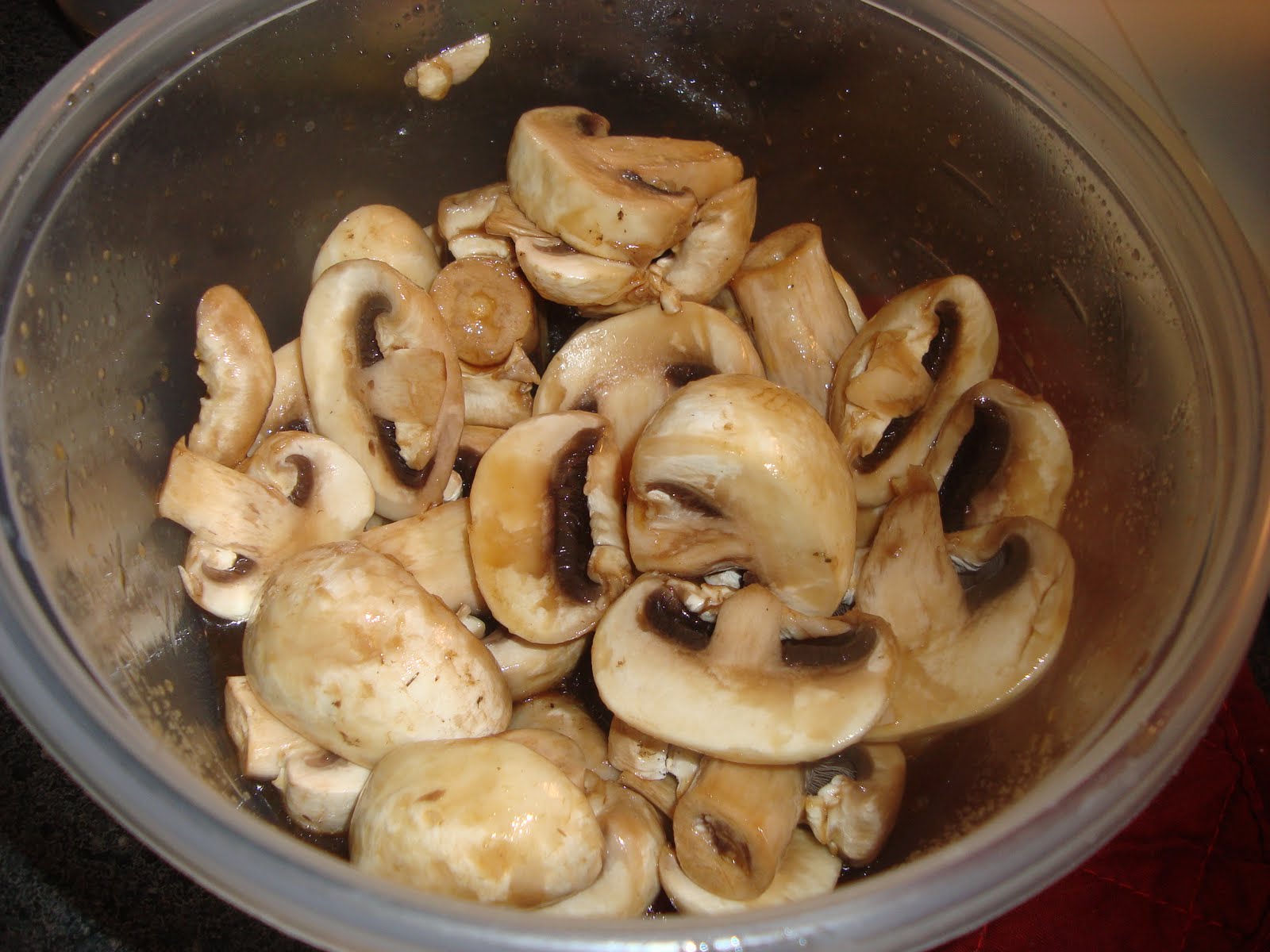
Marinated mushrooms (p.78) has to be one of the easiest recipes in TJOC. I sliced some mushrooms and soaked them in Ginger lemongrass vinaigrette (p. 575). I mixed lemongrass, ginger, white vinegar, water, and sugar together in a saucepan. I keep white vinegar under the sink since I mainly use it for cleaning, so it always seems strange to use it in a recipe.


When the sauce reduced, I whisked in sesame oil, vegetable oil, and soy sauce and poured it over the mushrooms.


As the mushrooms marinated, they soaked the dressing up.


Re-reading the recipe, I see I was supposed to drain them, but the mushrooms really soaked most of the dressing up. I didn't bother (mostly because I didn't actually read that directive but also because I didn't feel the need to serve them on toothpicks, so extra dressing didn't matter).

These were very popular and went very quickly leaving no leftovers. The lemongrass-ginger sauce had a terrific crisp flavor that really complimented the mushrooms. I think the vinaigrette would work very well as a marinade for grilled veggies too--I can easily imagine these mushrooms on a skewer.


Add to Technorati Favorites

Graduation weekend #1: Chickpea salad (p. 170), Tangy coleslaw (p. 161), and Spicy Chinese slaw (p. 161)

The next few posts need a bit of introduction (a happy introduction!).

Most of you know that I'm working on a PhD--I'm nearing the end (thankfully!) but my university only has graduation ceremonies in May and December. I was originally going to be finished within summer session (I will be done in September now) but because of the lack of an August graduation ceremony, I decided to walk (and get hooded) in the May ceremony.

My mom, her sister, her best friend, my dad, his brother, Josh's mother, and Josh's brother all traveled in for the ceremony and everyone stayed in the house for at least a few days. It was my first time to host that many people and took me a couple of months to get the house in shape. I learned a few things, like take the amount of toilet paper that you think you need and buy twice that.

The part (aside from the actual graduation) that I was the most excited about what cooking the meals. I thought we would have appetizers and cold salads as people trickled in on Thursday, our big dinner Thursday night (giving me an opportunity to cook a big piece of meat), and a nice brunch on Friday before the afternoon ceremony, which would really help my goal of "201 TJOC recipes in 2010".

My thought process with the cold salads was that they could be snacked on during the day on Thursday and kept in the fridge if people needed a snack.

The first salad I made was Chickpea salad (p. 170). The salad was simple. I mixed together chickpeas, roasted red peppers, onion, parsley, lemon juice, olive oil, Dijon mustard, and garlic. Simple!

Actually, the only disaster was while I was roasting the red peppers--I used too much olive oil and put the rack too close to the heating source and there was a small fire incident.


This is a hard salad for me to rate because I dislike red peppers--the chickpeas really soaked up the red pepper/onion flavor and the garlic and lemon juice gave it a nice kick. I think it was better the next day after it sat overnight and the flavors totally melded.

I thought that Tangy coleslaw (p. 161) would also be good. I like coleslaw but not enough to eat it for several days until it's gone, which is why I haven't made many of the coleslaw recipes in the past. I mixed scallions, rice vinegar, Worcestershire sauce, salt, pepper, and sugar together:


I then tossed cabbage, watercress, and a carrot with the mayo mixture:


And it was finished! I liked this dish. The watercress gave it a nice peppery kick and the carrots were nice and crunchy. I don't think it was particularly tangy but it wasn't the same ole boring coleslaw that I'm used to, so I liked it. It was easy and eye-catching--I think it would be a good choice to bring to a potluck.

Finally, I also made Spicy Chinese slaw (p. 161). I picked up a nice piece of diakon (a type of Japanese radish) at the grocery store and cut it into matchsticks. I ate a TON of diakon when I was in Japan--it's worked into essentially every dish and it's used in probably a hundred different ways.


Honestly, that is some of the best work I've ever done (sad but at least I'm improving!). I salted the daikon with a TON of salt.

I let it marinate and rinsed it off, then stirred in garlic, red pepper flakes, sugar, rice vinegar, olive oil, and sesame oil.


It was so pretty! But WAY too salty. WAY too salty. Rinse the heck out of the daikon. Rinse it until you think it's done and then rinse it some more. I imagine you salt it to reduce the moisture--which it definitely did--but the salt really soaked in. So it's really hard to judge because it was so salty. I think if it had less salt, it would have had a great spicy flavor. Has anyone else made this dish?


Add to Technorati Favorites